Hey all!
About a week ago, I was thinking what a great thing it would be if there were still reusable canning lids. How great it would be not to buy them again and again. Well, a couple days later I finally got around to looking, and found these.
http://www.reusablecanninglids.com/
Has anyone tried them? This is definitely something that I'm interested in, especially if I ever get to be the kind of gardener that actually has something to can! Let me know if they've worked for you.
I'm sort of discouraged as far as my garden goes right now. There are just so many insects ready to devour stuff! I'm not one to run out and buy sprays to coat all the plants with, ecpecially sallad greens. I don't know that much about gardening at all, much less about how to get rid of insect pests in safe ways. Now that my second crop is starting to grow, I have baby arugula, chard, broccoli raab and beet greens. I would like it if they had even a chance, but they're only 2 inches high and already full of tiny holes. I need a good source of information on organic plant protection. Does anyone have any recommendations for me? Something that's fairly simple to understand, and that I can learn from quickly in my "spare" time? I'd love any information you all can give me!
Friday, August 13, 2010


Thursday, August 12, 2010
Goat Feeding Tutorial
This post comes hot on the heels of the previous one, so be sure to go back to see an explanation of why this is here.
Here's a fairly easy method to estimate hay needs for goats. I used it to estimate how much hay to get to last our animals 6 months (October through March). I'm starting out with 2 Dwarf Nigerian Dairy goats that will be bred when I get them.
You'll start with the estimate that your goats will eat roughly 5% of their body weight in hay per day. You will need more than this, however, since there is waste. How much waste depends on the feeding system you have in place. Using a hay feeder that keeps the goats from laying on the hay and keeps the hay off the ground should result in 10 to 20% waste. You could estimate 15%.
I'm estimating my goats to weigh a combined total of 160 pounds when I get them. My equation will look like this:
160 (pounds) x .05 (percent turned to a decimal) = 8 (pounds of hay per day)
8 (pounds of hay per day) x 180 (days in 6 months) = 1440 (pounds of hay for 6 months)
1440 (6 months hay) x .15 (percent waste turned to decimal) = 216 (extra pounds needed for waste)
1440 + 216 = 1622 pounds of hay needed for 6 months
I've been extravagant with the amount of hay I purchased because the does will be in kid and we will have two breeding pairs of rabbits who also eat hay. I also didn't realize that the alfalfa bales would weigh so much more than the timothy.
So, now I have 25 bales of timothy hay at 50 pounds each = 1250 pounds
15 bales of Alfalfa hay at 100 pounds each = 1500 pounds
Total of 3050 pounds of hay. According to "the formula" this should be way more than we need.
I'll keep you posted.
I also wanted to say a word about the hay I chose and why. There are a lot of different ideas about what to feed goats even among experienced goeat farmers. One practice is to feed only the leafiest alfalfa that you can find. Proponents say that this is the best food for goats, they grow quickly and are well maintained on this hay.
The other practice is to feed only grass hay. Some say that the animals need the longer fibers in this hay to develop and work the rumen properly. They feel that the slower but steady growth is better for the goats in the long run, proving to make their frame stronger, be more gentle on their internal organ development and create a stronger, more disease resistant animal.
I've listened to people talk about these ideas, and read a ton about this. I have no experience with it at all so far myself. Because I don't know yet how I feel about this, I decided to go with a middle of the road approach. Feed some of each. My plan is to give them a limited amount of the alfalfa (say, about four pounds between them) and them fill the hay manger with the timothy free choice. We'll use the alfalfa for the rabbits too. They will probably eat a few pounds a day among them all.
The feed I chose is based on some information I read at this very informative website http://fiascofarm.com/goats/feeding.htm . I did, however, run into something that said to NEVER feed your goats equine feed mixes just a second ago. Ok, so opinions very a LOT. The site above, which I've gone to for info a lot in the past said that you should use equine feeds since they contain selenium and copper, which the goats need. Pregnant goats especially need selenium, as a shortage can cause spontanious abortion.
Ok, that's all for now!
Oops! I forgot to report on cost here. This information will be accurate only for my area of the country though. I'm far from the city and also far from the farming communities here in MN. I chose to go through a trusted distributor, so it's coming second party and I'm sure more expensive than if I could get it straight from the person who cut the hay.
Timothy 50 lbd. bales $4.95/ea
Alfalfa 100 lbd. bales $11.95/ea
bedding straw $5.95/ea
Purina Horse Chow #200 50 lbd. bags $12.95/ea
egg mash 100 lbd. bags $17
scratch 100 lbd. bags $14.50
Here's a fairly easy method to estimate hay needs for goats. I used it to estimate how much hay to get to last our animals 6 months (October through March). I'm starting out with 2 Dwarf Nigerian Dairy goats that will be bred when I get them.
You'll start with the estimate that your goats will eat roughly 5% of their body weight in hay per day. You will need more than this, however, since there is waste. How much waste depends on the feeding system you have in place. Using a hay feeder that keeps the goats from laying on the hay and keeps the hay off the ground should result in 10 to 20% waste. You could estimate 15%.
I'm estimating my goats to weigh a combined total of 160 pounds when I get them. My equation will look like this:
160 (pounds) x .05 (percent turned to a decimal) = 8 (pounds of hay per day)
8 (pounds of hay per day) x 180 (days in 6 months) = 1440 (pounds of hay for 6 months)
1440 (6 months hay) x .15 (percent waste turned to decimal) = 216 (extra pounds needed for waste)
1440 + 216 = 1622 pounds of hay needed for 6 months
I've been extravagant with the amount of hay I purchased because the does will be in kid and we will have two breeding pairs of rabbits who also eat hay. I also didn't realize that the alfalfa bales would weigh so much more than the timothy.
So, now I have 25 bales of timothy hay at 50 pounds each = 1250 pounds
15 bales of Alfalfa hay at 100 pounds each = 1500 pounds
Total of 3050 pounds of hay. According to "the formula" this should be way more than we need.
I'll keep you posted.
I also wanted to say a word about the hay I chose and why. There are a lot of different ideas about what to feed goats even among experienced goeat farmers. One practice is to feed only the leafiest alfalfa that you can find. Proponents say that this is the best food for goats, they grow quickly and are well maintained on this hay.
The other practice is to feed only grass hay. Some say that the animals need the longer fibers in this hay to develop and work the rumen properly. They feel that the slower but steady growth is better for the goats in the long run, proving to make their frame stronger, be more gentle on their internal organ development and create a stronger, more disease resistant animal.
I've listened to people talk about these ideas, and read a ton about this. I have no experience with it at all so far myself. Because I don't know yet how I feel about this, I decided to go with a middle of the road approach. Feed some of each. My plan is to give them a limited amount of the alfalfa (say, about four pounds between them) and them fill the hay manger with the timothy free choice. We'll use the alfalfa for the rabbits too. They will probably eat a few pounds a day among them all.
The feed I chose is based on some information I read at this very informative website http://fiascofarm.com/goats/feeding.htm . I did, however, run into something that said to NEVER feed your goats equine feed mixes just a second ago. Ok, so opinions very a LOT. The site above, which I've gone to for info a lot in the past said that you should use equine feeds since they contain selenium and copper, which the goats need. Pregnant goats especially need selenium, as a shortage can cause spontanious abortion.
Ok, that's all for now!
Oops! I forgot to report on cost here. This information will be accurate only for my area of the country though. I'm far from the city and also far from the farming communities here in MN. I chose to go through a trusted distributor, so it's coming second party and I'm sure more expensive than if I could get it straight from the person who cut the hay.
Timothy 50 lbd. bales $4.95/ea
Alfalfa 100 lbd. bales $11.95/ea
bedding straw $5.95/ea
Purina Horse Chow #200 50 lbd. bags $12.95/ea
egg mash 100 lbd. bags $17
scratch 100 lbd. bags $14.50
Wednesday, August 11, 2010
Hay Delivery Day
It was hay and feed delivery day yesterday. The kids and I helped unload and stack 60 bales of straw and hay and 600 pounds of feed. The bales ranged from about 50 pounds for timothy to over 100 for alfalfa. For some ungodly reason, we stacked the alfalfa last. Oh my, was I ever ready to die! For some reason, after we were all finished, I snapped a picture of my self after we were done. I was so embarrassed when I saw that picture! My face was SO red from the exercise and heat. The hay delivery dude saw me like THAT!? It's a good thing I've already got a great guy and don't have to impress anyone else!

Here's the hay on the truck.

We found a snug little cave where something had made a home in the straw.

Here's one pile of straw.

Alfalfa on the right and straw on the left.
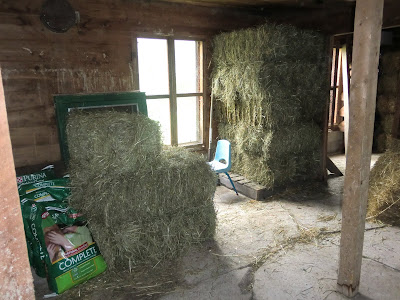
Timothy (and there's more!)
I also got some 16 percent protein horse chow for the goats. All that hay and feed sure makes the barn smell wonderful! I just love the smell of horse chow. It's grains mixed with molasses and minerals, and it smells so sweet.
One on the things I'd like to do with this blog is help others to see how much it costs to raise livestock of different kinds and what can reasonably be expected as a return. Of course, there are returns that cannot be measured financially, like fresh air, exercise and satisfaction. However, I know that for myself, I tried so hard to find some clear information on how much it might cost to keep the goats, and how much feed and hay I would need, and it was oh so hard to find anything. I finally found an equation that would help me to get a rough estimate on what I would need for hay. I hope to share what I'm finding and what I discover along the way with anyone interested in trying to figure it all out. So, my next post is going to be a description of what I've purchased and the cost, and an equation to help anyone else who's trying to figure this all out. As I go along with all of this, I'll report on the outcome of the decisions that I made. See ya next time!

Here's the hay on the truck.

We found a snug little cave where something had made a home in the straw.

Here's one pile of straw.

Alfalfa on the right and straw on the left.

Timothy (and there's more!)
I also got some 16 percent protein horse chow for the goats. All that hay and feed sure makes the barn smell wonderful! I just love the smell of horse chow. It's grains mixed with molasses and minerals, and it smells so sweet.
One on the things I'd like to do with this blog is help others to see how much it costs to raise livestock of different kinds and what can reasonably be expected as a return. Of course, there are returns that cannot be measured financially, like fresh air, exercise and satisfaction. However, I know that for myself, I tried so hard to find some clear information on how much it might cost to keep the goats, and how much feed and hay I would need, and it was oh so hard to find anything. I finally found an equation that would help me to get a rough estimate on what I would need for hay. I hope to share what I'm finding and what I discover along the way with anyone interested in trying to figure it all out. So, my next post is going to be a description of what I've purchased and the cost, and an equation to help anyone else who's trying to figure this all out. As I go along with all of this, I'll report on the outcome of the decisions that I made. See ya next time!
Monday, August 9, 2010
Garden Discription
A few people have asked me about my garden space, so here's the info for you, humble as it is. :)
My new garden space is about 10 x 40 ft. The one next to it that I'm using is about 5 x 30, so it's a huge improvement!
I also have a new bed near the house that's about 5 x 10. It has the squash planted in it this year, along with one unproductive tomato plant. That's all I could manage because I've been digging that one out with a shovel and removing all the matted grass roots and the rocks and loosening all the dirt for about 18 inches down, then adding rabbit manure. I basically got all of the edges done, and then dug 4 deep holes that I put compost in the bottom of for the squash. Next spring that will be ready for something special, but I haven't decided exactly what yet. An herb garden near the house? A strawberry bed? Hmm... The following picture is what it looks like now. So, next year I hope to be gardening in about 650 square feet. I'm immagining all the possibilities now!

Today I pruned the tomato and squash plants. Does anyone else find it hard to change gears like that? Just a month ago we were all rooting for our plants to grow, and now we're cutting it away? It always gives me a strange feeling to be cutting them back, but hopefully that will make the difference between tons of marble sized tomatoes and a few big, ripe ones. And maybe a squash or two? I'm still holding out hope! :)
By the way, thanks to everyone who reads and comments on this blog. It has really helped me to keep going on all these projects that I feel are important in so many ways. I immagine some built in accountability from telling others what I'm doing and what my plans are. Don't you find yourself more likely to follow through on something if you've told others about it?
My new garden space is about 10 x 40 ft. The one next to it that I'm using is about 5 x 30, so it's a huge improvement!
I also have a new bed near the house that's about 5 x 10. It has the squash planted in it this year, along with one unproductive tomato plant. That's all I could manage because I've been digging that one out with a shovel and removing all the matted grass roots and the rocks and loosening all the dirt for about 18 inches down, then adding rabbit manure. I basically got all of the edges done, and then dug 4 deep holes that I put compost in the bottom of for the squash. Next spring that will be ready for something special, but I haven't decided exactly what yet. An herb garden near the house? A strawberry bed? Hmm... The following picture is what it looks like now. So, next year I hope to be gardening in about 650 square feet. I'm immagining all the possibilities now!

Today I pruned the tomato and squash plants. Does anyone else find it hard to change gears like that? Just a month ago we were all rooting for our plants to grow, and now we're cutting it away? It always gives me a strange feeling to be cutting them back, but hopefully that will make the difference between tons of marble sized tomatoes and a few big, ripe ones. And maybe a squash or two? I'm still holding out hope! :)
By the way, thanks to everyone who reads and comments on this blog. It has really helped me to keep going on all these projects that I feel are important in so many ways. I immagine some built in accountability from telling others what I'm doing and what my plans are. Don't you find yourself more likely to follow through on something if you've told others about it?
Subscribe to:
Posts (Atom)